The calculus covered in this article serves physics competition and focuses on practicality rather than rigor
Sequence limit
Introduction
Let
It can be known that is getting closer and closer to 1, but when is infinite, is actually 1?
From this, we introduce the language from the perspective of error:
ϵ−N language
If there exists an such that: for any real number , there is an integer , such that for any , , then is called the limit of the sequence , denoted as . Otherwise, it is called the sequence without limit.
Function limit
Introduction
With the limit of the series (sequence), the limit of the function is naturally derived.
When , what is the value of ?
In the same way, the language is introduced
ϵ−δ language
If there is a such that: for any , if there is , such that when , , then the left limit of at is called , recorded as
In the same way, it is easy to get the definition of right limit.
In addition, if , then the limit of at is , denoted as
The above ϵ−N language/ϵ−δ language is not the focus of this section
Useful limit judgment rule
Pinching theorem
If , and limits exist and are the same, then limits exist and are the same.
Example 1
Feel (loosely)
From the relationship between the area and size of the unit circle, we are familiar with
Therefore, there is the inequality
Because the limits of at 0 are all 1, so:
Extreme algorithm
It is easy to prove that the limit of the four arithmetic operations is equal to the four arithmetic operations of the limit:
If , then:
If , then:
Example 2
Calculate the limit (the limit does not necessarily exist)
, there is no limit According to the pinch theorem: The left and right limits are equal to 0, so the required limit is 0.
Derivative
Introduction
Considering the function , what is the instantaneous rate of change of the function at ?
Let’s first consider the average rate of change from to :
When , the average rate of change approaches , which is the instantaneous rate of change of at , that is, the derivative.
Derivative ↔Micro-Business
Differential is a small amount of change. The quotient of differential is called differential quotient.
Definition
Definition of derivative
If the limit
exists, then is said to be differentiable at , and this limit value is called the derivative of at , denoted as or .
If is differentiable at every point in the domain of definition, then is called the derivative function of , referred to as derivative.
The above strict definition is not the focus of this section, the important thing is to calculate the derivative.
Derivatives of common functions
Starting from the definition, the following common conclusions can be derived:
Function
Derivative
(constant)
Example: Derivation from definition
Four arithmetic rules for derivatives
Rules
Assume that can all be derived, then:
Addition and Subtraction Rule:
Multiplication Rule:
Division rule: , where
Memory Tips: Multiplication rule - "Lead before and after, add lead without lead, then lead after lead"; Division rule - "Lead up and down minus lead up and down, divide the square of the following".
Derivation of the multiplication rule
Adding and subtracting the same term :
Example questions
Example 1
Find the derivative of .
By the multiplication rule:
Example 2
Find the derivative () of .
By the division rule:
Example 3
Find the derivative of .
By the multiplication rule:
Example 4
Find the derivative of .
Convert by the division rule:
Physical applications of derivatives
The point symbol is Newton notation, which means derivation with respect to time.
Example 1
Use derivatives to find the velocity and acceleration of uniform circular motion with angular velocity . So So
Example 2
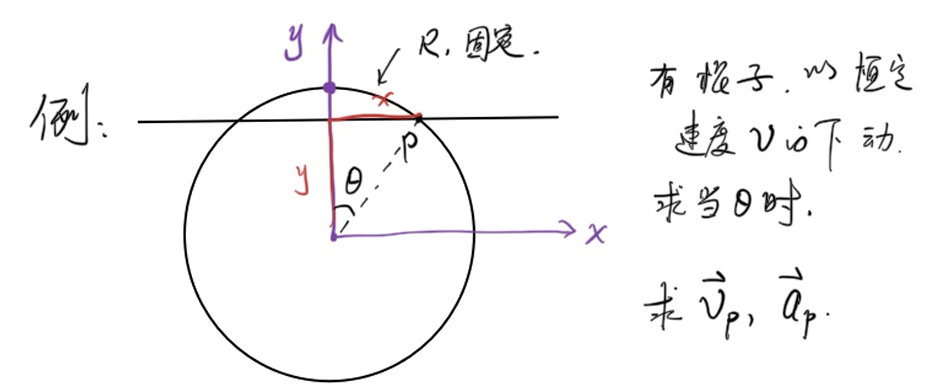
There are two ways to deal with this problem:
Decompose in Cartesian coordinate system
Decomposition in polar coordinate system
Method 1
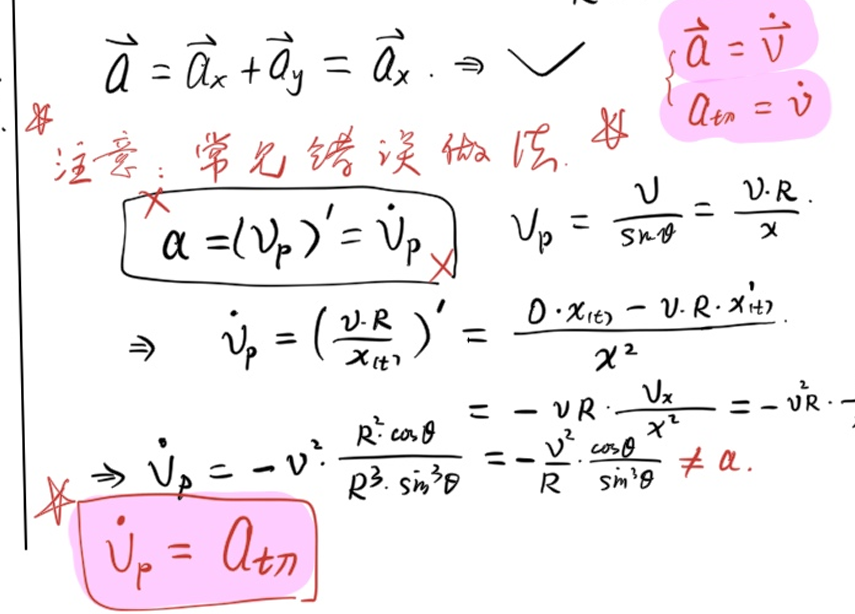
Let’s start timing from the top of the circle: So (easy to get by decomposing speed) There is a common mistake to note here:
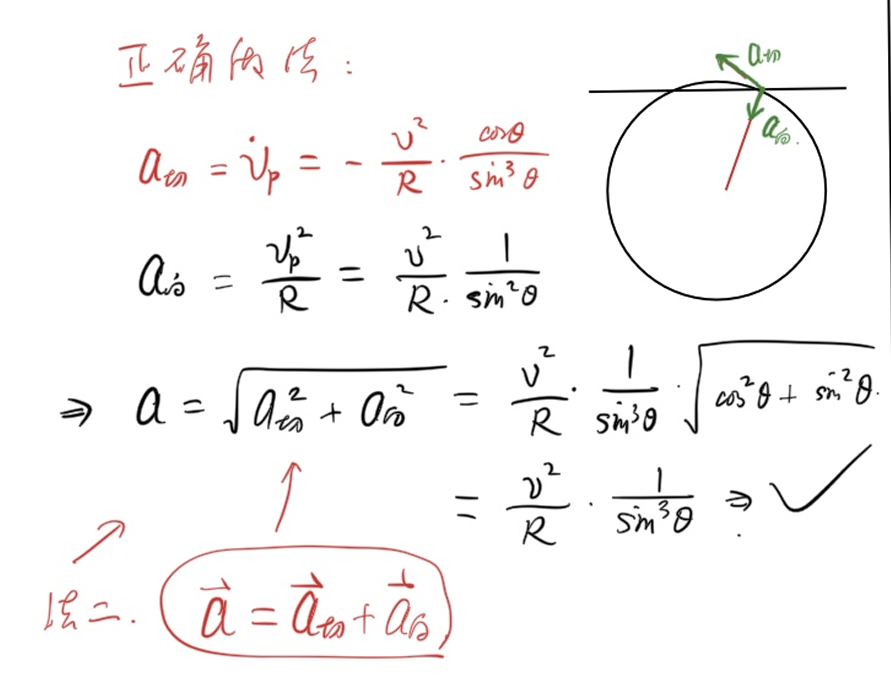
After correction, we get:
Method 2
AI Summary (Sonnet 4.6)
Introduction to the Basics of Calculus (for physics competitions, focusing on practical applications) is divided into three major sections:
Limit: From the sequence limit (ε-N) to the function limit (ε-δ), master the pinch theorem and the four arithmetic rules, and be able to calculate common limits.
Derivatives: Understand the essence of "instantaneous rate of change is the limit", memorize the derivative tables of common functions, and master the three major operation rules of addition, subtraction, multiplication, and division.
Physics Application: Velocity , acceleration , use parametric equations + derivation to deal with geometric problems such as circular motion.
Comments
Comments
Sign in to join the discussion. Email is verified only when you register.
Loading comments…