When dealing with Example 1 (4) (5), you can also use the analogy of and consider the squares and then add them.
Example 2
If and have three intersection points, find the value range of :
When , increases monotonically, and are inverse functions of each other, then if the intersection point is not on :
Suppose the intersection point is , then there must be a pair of intersection points , and as long as , it is inconsistent with monotonicity.
This means that as a downward convex function has two intersection points with , which obviously leads to a contradiction:
Therefore, , at this time, there is obviously an intersection point , and the other two intersection points cannot be on , then the two paired intersection points are not on , and there is a pair of that is an intersection point that meets the meaning of the question:
Let , then:
Order again
(5)/(6):
The above are the necessary conditions for the existence of .
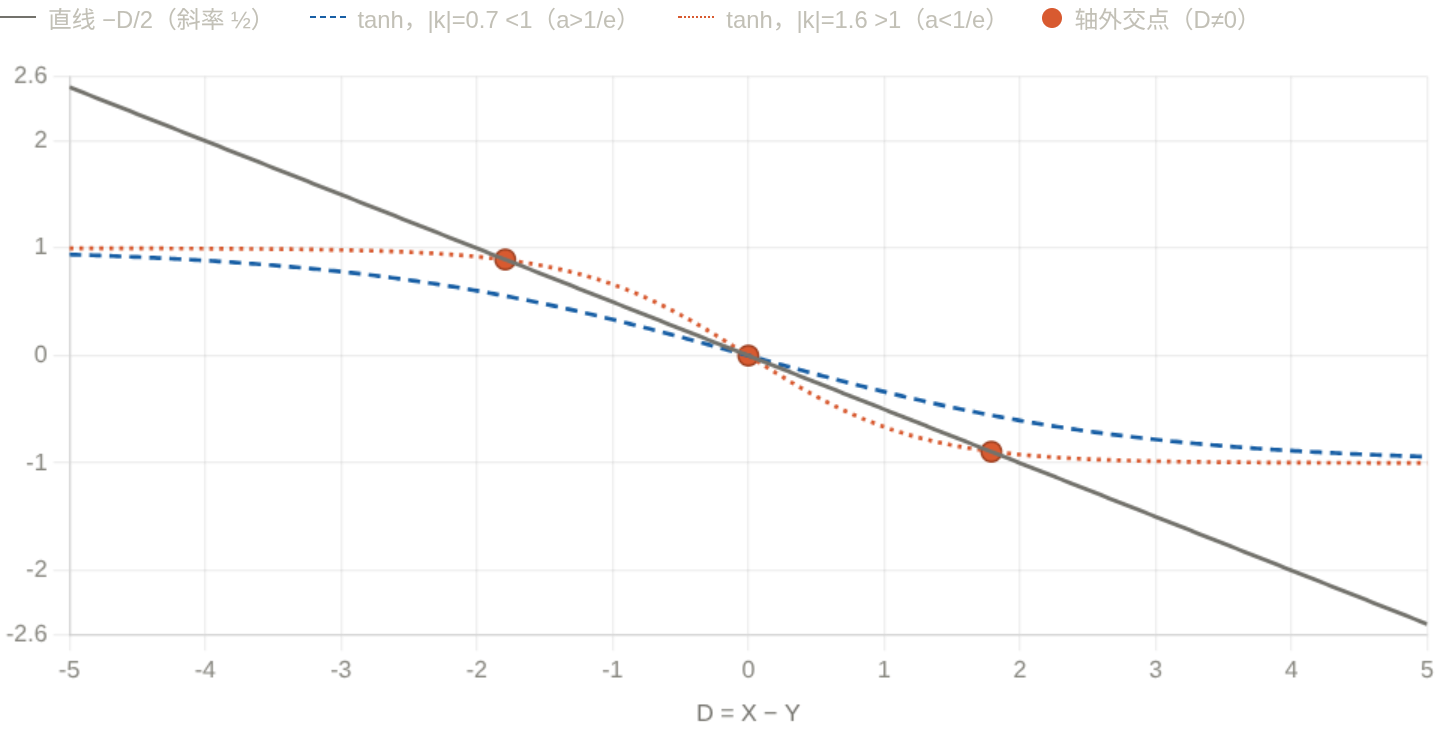
When is fixed, is a straight line, considering that it has three intersection points with .
Obviously, it can be seen from the image that the slope of at is .
Then if , then the straight line and the hyperbolic tangent function will have three intersection points.
If , then there is only one intersection point between the straight line and the hyperbolic tangent function.
From (3):
If , then , resulting in a contradiction.
So .
Critical condition
Replace "ratio slope at " with a single variable, global argument to completely avoid the trouble of entanglement of two unknown quantities. The cleanest thing is to go back to a fixed point language.
Assume (), the axis outer pair is the fixed point of except . inspection
**Step 1: Up to 3 zero points. ** To calculate the derivative, record , then
Moreover, is strictly increasing, so first decreases and then increases and has a unique minimum. Therefore, when the base is less than 1, first increases and then decreases. Thus is also unimodal: although it tends to at both ends, it may become positive in between. Hence changes sign at most twice, and has a decrease–increase–decrease profile with at most three zeros. By inverse-function symmetry, nontrivial zeros occur in pairs, so there is at most one off-axis pair.
**Step 2: The threshold is exactly . ** At the known zero point ,
If (i.e. ): then . Combined with the single-peak structure, it can be verified that no longer crosses zero on both sides of (it crosses down at , and both ends are also facing , and the positive peak in the middle cannot reach to create a new intersection point if it exists), so there is only one zero point** and only one intersection point for .
If (that is, , because is ): then , crosses the zero point at . However, and (use to directly test the limits at both ends), combined with the "decrease, increase and decrease" shape caused by a single peak, forces a new zero point on both sides**, which is exactly a pair of off-axis solutions.
**Step Three: Continuity Closure (replacing your ). ** The second step is sufficient and necessary, but if you want to clarify "why this pair of solutions was born at ": continues with , and when is , the pair of zero points are continuously merged into (that is, ). This is the correct origin of the "" phenomenon - it is the ultimate behavior of the conclusion, not a criterion used as a premise.
Therefore, it is important to:
Example 3
(2021 Tsinghua Strong Foundation) defines , then __.
It is not difficult to see that the background of this question is the hyperbolic tangent function.
Let , where:
Note , then:
Among them
What you want
Comments
Comments
Sign in to join the discussion. Email is verified only when you register.
Loading comments…