Starting from a multiple-choice triangle problem: a proof that sin²A + sin²B = sin C forces C = 90° when A and B are acute, and the complete solution set of the equation, which shows why the acute condition can't be dropped: without it, C can be any acute angle.
Problem 1 (source: the WeChat account "浙江省高中数学", Zhejiang High School Mathematics). The area of is , and . Which of the following are true?
A. B.
C. D.
Problem 2 (source: a Bilibili video). In , and are acute and . Prove that .
Option A of Problem 1 is exactly the hypothesis of Problem 2. Below, I prove Problem 2 first, use it to solve Problem 1, and then answer the question: does the conclusion still hold without " and are acute"?
Proof of Problem 2
Method 1: compare sizes
Since , the condition can be rewritten as
Because , the angles and are also in , where sine is increasing.
If , then , so . In the same way, . Since , the left side is positive, a contradiction.
If , both brackets are negative in the same way, so the left side is negative, a contradiction.
So , that is, . Conversely, when we have and , and the equation holds.
Method 2: sum-to-product
so the condition is equivalent to
and are acute, so and .
If , the left side of (1) is positive while the right side is negative, a contradiction.
If , then and , so . Multiplying by gives so and therefore , a contradiction.
So . Method 2 takes a few more steps, but (1) is useful again later: it gives every solution of the original equation.
Back to Problem 1
A is true. Using and , the first condition becomes
To use Problem 2 next, we first need and to be acute. The second condition provides this: and , so and have the same sign. A triangle has at most one obtuse angle, so they can't both be negative. They are both positive, so and are acute. By Problem 2, .
Then and , so the second condition becomes , that is, . So or .
B is true. Let the hypotenuse be . Then and , and the area is
so and .
C is true..
D is false..
Answer: ABC.
Why A and B must be acute
In Problem 1, " and are acute" was deduced from , and that step can't be skipped. Here is why: on its own does not make a right angle.
Rewriting it with sides
By the law of sines, and so on, so the condition becomes
that is, . Comparing this with the law of cosines, , gives
When both sides are , so (2) holds in every right triangle. When :
can't be obtuse. The left side of (2) would be negative and the right side positive.
can be any acute angle. Then (2) can be written as
The right side is greater than , so there is always a ratio that satisfies it. Two sides and the angle between them determine a triangle, and that triangle satisfies the original equation with . By Problem 2, its angles and can't both be acute. Neither can be a right angle either: if , then . So exactly one of and is obtuse.
A concrete counterexample
Take . Then , so and . Take
You can check it directly:
By the law of cosines, so .
, so .
, so is obtuse.
Numerically, , and . The equation holds, but the triangle isn't a right triangle.
Every solution
(1) shows the same thing. When ,
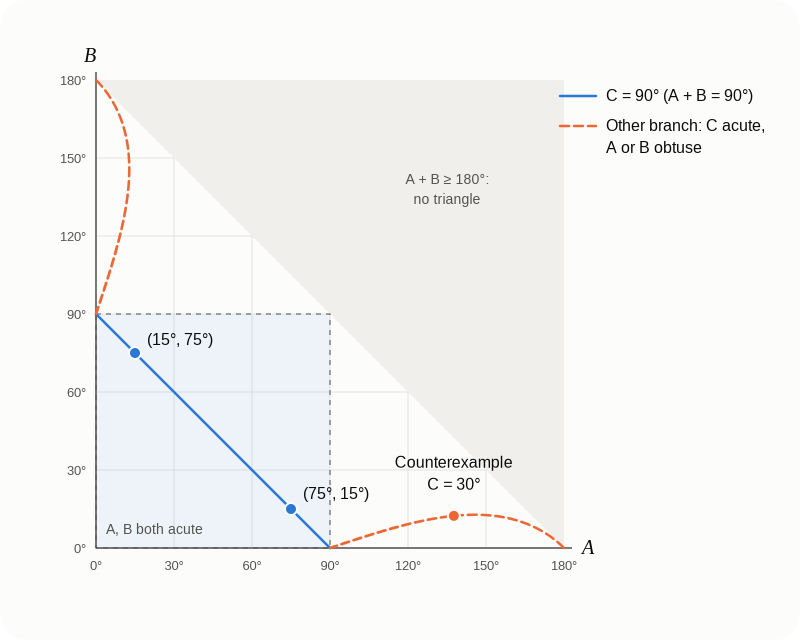
For acute the right side is in , so and the larger of the two angles must be obtuse. Here are all the solutions in the plane:
The blue line is the C = 90° solutions. The dashed orange curves are all the others; they lie where A > 90° or B > 90°, and the smaller angle never exceeds about 12.8°.
The square in the lower left is where and are both acute. The only solutions there are on the blue line , which also contains the two solutions of Problem 1, and . One orange branch starts at and runs close to the horizontal axis to . The other is its reflection in the line . Along each branch, falls from to , and every triangle on it is obtuse. The hypothesis of Problem 2 rules out exactly these two branches.
Summary
In a triangle, holds if and only if
, or
is acute and , in which case one of and is obtuse.
So the condition " and are acute" is necessary. By the analysis above, any of the following can replace it, and the conclusion still follows:
;
is not acute (obtuse is already ruled out);
, as in Problem 1.
Comments
Comments
Sign in to join the discussion. Email is verified only when you register.
Loading comments…