(2024·Xuzhou Simulation) For the sequence where each item is a positive integer, define transformations and to transform the sequence into the sequence . For the sequence in which each item is a non-negative integer, define , define transformations , Arrange the items in the sequence from large to small**, and then remove all zero items to obtain the sequence .
(1) If the sequence is , find the value of .
(2) For the finite sequence where each item is a positive integer, let , .
(i) Explore the relationship between and ;
(ii) Proof: .
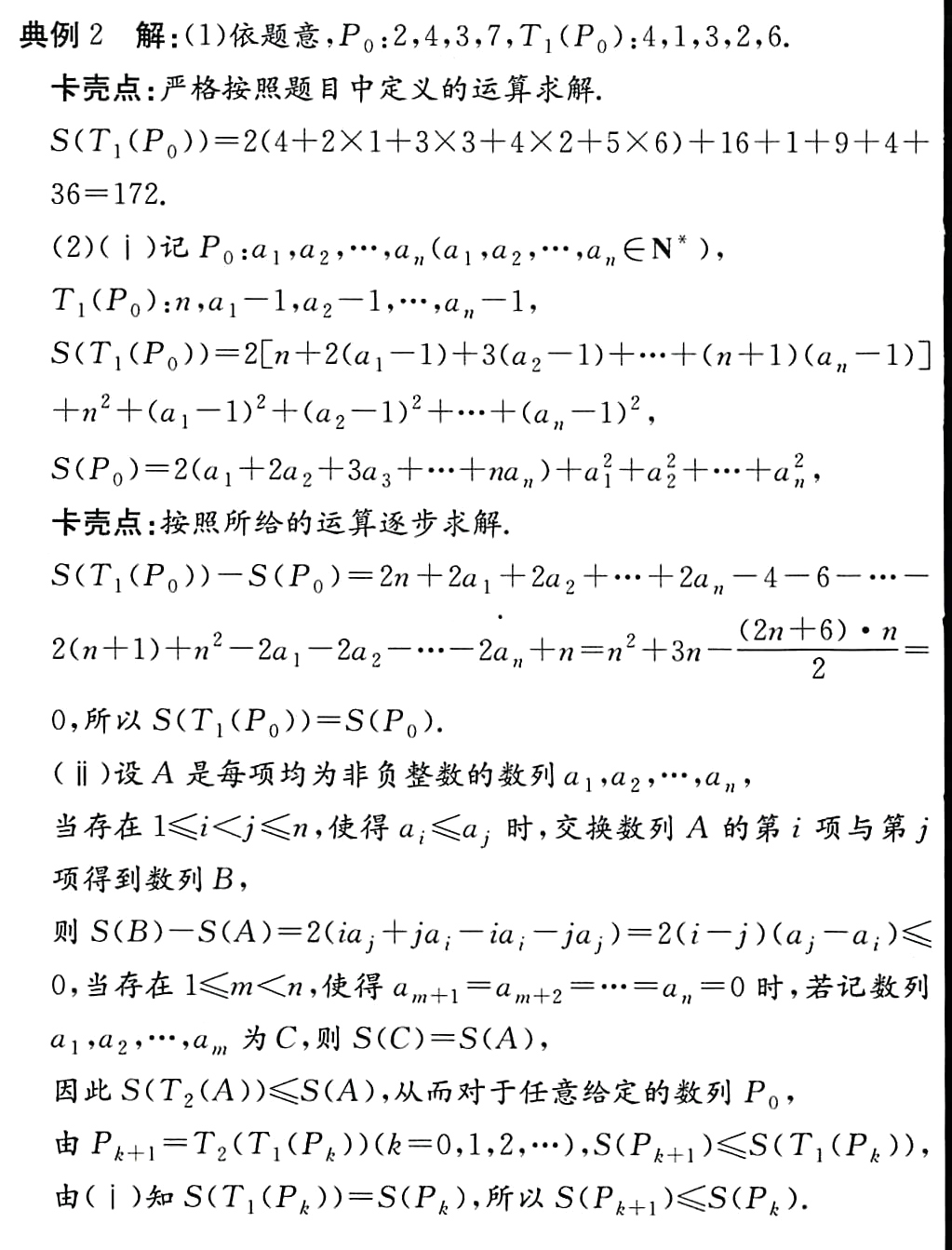
(1) ,
(2)(i)
(ii)
From (i) we know: , only causes to become smaller:
Proof below: .
The operation** will not change the size of the sum of squares**, but putting the large number in the front will have a smaller coefficient; putting the small number in the back will have a larger coefficient, which is equivalent to a smaller reverse sum.
[!TIP] Pay attention to the operation sequence of Arrange the terms in the sequence from large to small**, and then remove all zero terms
Although the final results of Remove zeros first and Sort first are the same, this order can assist us in the writing process.
The answer is relatively normal, which is equivalent to proving the sorting inequality
Why is it more difficult to write remove zeros first? Because if remove zeros first, if there are 0s in the middle, then the value of may be adapted. And sort first makes 0s at the end, and removing zeros does not affect .
Another solution: completing the square makes (i) and (ii) one line each (added by Claude)
This section was added by Claude, an AI model made by Anthropic, after the author's solution. It is not written by the original author.
For any sequence of non-negative integers , since ,
(i) The first term of is and term is , contributing and :
(ii) . Sorting leaves unchanged, and by the rearrangement inequality is smallest in decreasing order. The zeros then sit at the end, where each contributes , so removing them does not change . Hence , and with (i), .
Finally, I’ll add one more question, taken from the 2026 Beijing No. 2 Middle School Grade 2 (Part 2) Grade 4 exam:
(III) Prove that for any finite sequence whose terms are positive integers, there exists a positive integer such that .
[!TIP] Consider the boundedness, monotonicity and discreteness of S
(21) (2025 Daxing) (15 points for this question)
For a positive integer , define as the sum of the squares of each digit of . It is known that the infinite sequence satisfies: is a positive integer, and for any , .
(I) If , find the value of ;
(II) If is a three-digit number, is there such that is incremented? If it exists, find all the values of that meet the conditions; if it does not exist, explain the reason;
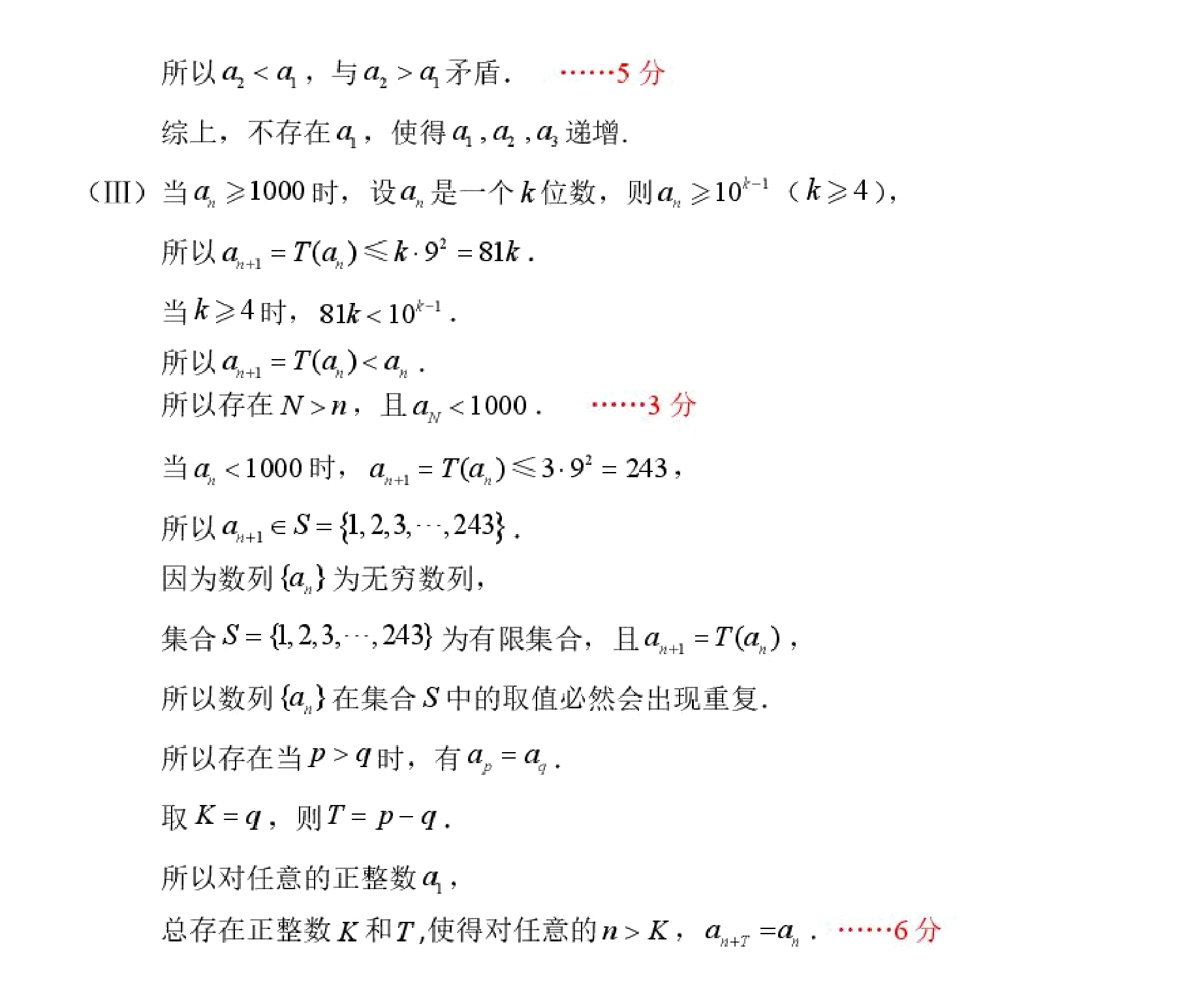
(III) Prove: For any positive integer , there are always positive integers and , such that for any , .
(III) of the two questions are exactly the same, both making use of discreteness and boundedness, leaving it to the readers to think for themselves.
Solutions to both parts (III) (added by Claude)
This section was added by Claude, an AI model made by Anthropic, after the author's solution. It is not written by the original author.
Xuzhou problem (III). By (ii), , and every is a non-negative integer. A non-increasing sequence of non-negative integers can only drop finitely many times (the total drop is at most ), so there is a with for all .
Daxing problem (III). If has digits, then ; if , then . So once the sequence is below it stays there, and until then every step strictly decreases it, so it enters after finitely many steps. In that finite set the pigeonhole principle gives with , and since depends only on , the sequence repeats with period from on. Take and period .
Loading comments…